
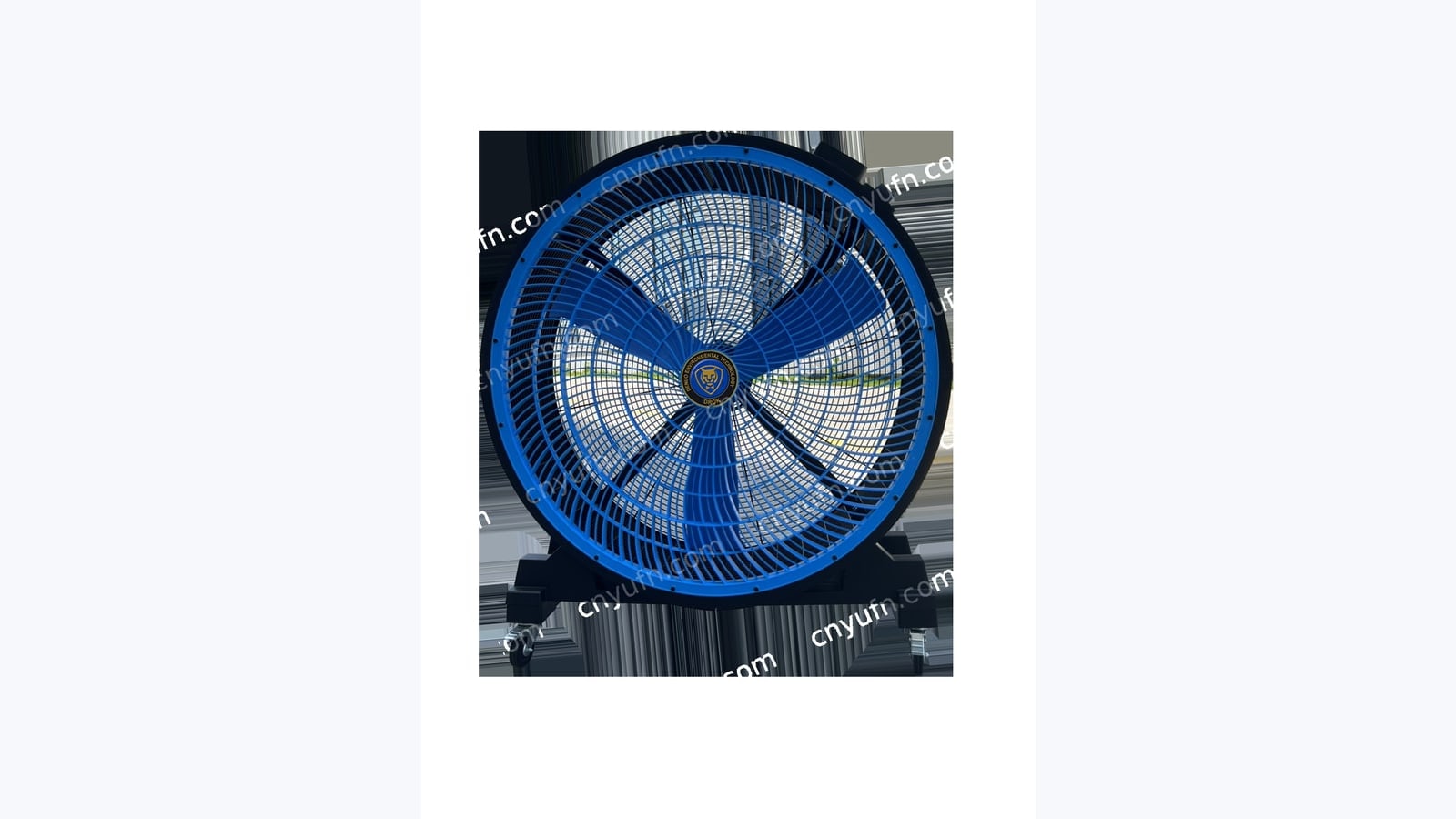
Industrial Floor Drum Fan Assembly Production Line Case

blue industrial floor circulation fan product

black and blue portable industrial drum fan

heavy duty mobile drum fan front structure

industrial mobile fan with caster wheels

Project Overview

This case is designed for manufacturers of industrial floor drum fans and mobile air circulation fans. The images show round guard fans, mobile base structures, and large-diameter blade products used in factories, warehouses, service workshops, logistics centers, and large commercial spaces.

Fan and ventilation equipment may look like ordinary assembly products, but stable delivery depends on much more than final assembly. A factory must manage blades, guards, motors, brackets, fasteners, electrical testing, noise control, vibration checking, appearance protection, packaging, and shipment schedules. Taizhou Yufeng Intelligent Equipment Co., Ltd. plans fan assembly lines, industrial fan production lines, ventilation equipment assembly lines, and large-space air circulation equipment production lines as complete manufacturing systems. For overseas buyers, a clear line layout and visible testing process often create more trust than a product photo alone.

Customer Pain Points

The most common customer pain point is that the product is bulky while parts are numerous. Guards, motors, blades, brackets, casters, and controls are often scattered across the workshop. Without fixed workstations, operators move large guards and motors too often, reducing efficiency and increasing appearance damage risk.

Many fan manufacturers start with manual benches and temporary fixtures. This can work for small orders, but once export orders, brand customers, and batch production increase, hidden problems become obvious. Blades, guards, motors, brackets, and packaging materials occupy too much workshop space. Operators walk too often to pick parts. Different fan models may have very different sizes, so a rough workstation arrangement leads to slow changeover and unstable takt time. At the same time, fan products require noise, vibration, electrical safety, and appearance checks. If testing is only done at the end, defects create rework pressure and delay delivery.

Yufeng Solution Design

For mobile industrial fans, Yufeng recommends separating guard pre-assembly, motor installation, blade fastening, front and rear guard assembly, base and caster installation, running test, and packaging. Large-part handling can use roller conveyors, mobile tooling carts, or lifting platforms. Torque tools can be used for key fastening points, and the test area can check noise, vibration, and safety protection.

Yufeng does not simply place conveyors in a workshop. We first build the process route around the product family. Small and medium fan products can use belt conveyors, roller conveyors, assembly benches, and test stations. Large industrial fans and HVLS ceiling fans require blade protection, long-part handling, assisted lifting, multi-operator cooperation, and safe working distance. Exhaust fans and louver fans require stable positioning for housings, guards, motors, and shutter parts. The line can reserve barcode traceability, test data recording, work instruction displays, and photo record interfaces for future digital upgrades.

How the Line Solves Buyer Concerns

The solution helps customers reduce bulky part handling, lower blade and guard scratch risk, and produce different fan sizes under a similar process route. The workshop becomes cleaner, and customers can clearly see the process from parts to final testing during factory audits.

From a business perspective, a fan assembly line is not only a production tool. It is also part of the factory presentation for international customers. When buyers see clear workstations, standardized testing areas, practical material flow, and organized packaging, they can better trust the supplier's long-term delivery capability. Production managers benefit from clearer workstation responsibility, less material waiting, easier worker training, and more predictable output. Quality teams can move noise, vibration, electrical safety, and appearance checks into the process instead of leaving all inspection pressure to the final stage.

Recommended Configuration

Configuration area Recommended approach
Line layout Plan blade, guard, motor, bracket, final test, and packaging areas separately
Workstation design Use anti-scratch benches, torque tools, material bins, work instructions, and safe access
Handling method Use belt or roller conveyors for smaller fans, and mobile tooling, lifting tables, or assisted hoists for larger fans
Quality control Check air volume, noise, vibration, electrical safety, appearance, screw torque, and running stability by process stage
Future upgrade Add barcode traceability, test data recording, photo records, station status displays, and MES interfaces

Suitable Applications

Suitable for industrial floor drum fans, mobile drum fans, air circulation fans, warehouse ventilation fans, workshop cooling equipment, and large round fan manufacturers.

This solution is suitable for companies that are developing overseas customers, facing growing order volume, increasing model variety, compressed delivery time, or stricter factory audit requirements. The first stage does not need to be fully automatic. A practical upgrade can begin by standardizing logistics, assembly, testing, and packaging. The second stage can add barcode traceability, test data records, key-station mistake proofing, and automatic inspection. The third stage can introduce robotic handling, automatic screwdriving, automatic testing, or MES integration according to budget and production scale.

Purchasing Recommendations

When buying a fan production line, do not judge only by machine price. Buyers should confirm whether the supplier understands the real assembly issues of fan products: blade scratching, guard positioning, motor weight, assisted lifting, final test convenience, rework path, packaging protection, and model changeover. Before requesting a quotation, prepare product photos, size range, weight, target capacity, current workshop layout, test items, packaging method, and export market requirements. The more complete the information, the easier it is to make an accurate line concept, budget estimate, and delivery plan.

Recommended Automation Upgrade Path

For fan manufacturers, Yufeng usually recommends a phased automation upgrade instead of making every process fully automatic from the beginning. The first stage should focus on workshop order and basic efficiency: parts storage, workstation rhythm, product transfer, testing area, and packaging flow should become fixed and visible. Operators know where every action should be completed, and managers can quickly identify the bottleneck station. The second stage can add dedicated fixtures, torque tools, mistake-proofing devices, barcode checking, test data records, and key part traceability, so quality problems can be traced back to specific processes. The third stage can introduce automatic screwdriving, automatic testing, robotic handling, automatic labeling, automatic packaging, or MES integration, but these upgrades should be built on a stable process route.

From a return-on-investment perspective, the first value of a fan assembly line is often not full labor replacement. The faster benefit comes from reducing unnecessary handling, rework, waiting time, material mixing, appearance damage, and customer audit pressure. Industrial fans, HVLS ceiling fans, exhaust fans, and ventilation equipment usually include large guards, long blades, motors, and packaging materials. These parts occupy space and are easy to damage when handled casually. A standardized line layout can improve the workshop immediately. For export-oriented factories, production line images, testing stations, packaging flow, and quality records should also become sales materials because they help build trust with overseas buyers.

Delivery, Maintenance and Long-Term Operation

Long-term line stability depends on whether the design considers maintenance convenience. A fan assembly production line should reserve enough access for material supply, cleaning, repair, and fixture replacement. Test stations should make running status and test records easy to check. Large-part handling areas should avoid crossing worker paths. Packaging areas should include temporary buffers so the whole line does not stop when packaging materials are delayed. For export factories, English operation instructions, wearing part lists, maintenance schedules, common troubleshooting notes, and FAT videos are also recommended. These materials help internal training and show professionalism during remote communication or customer audits.

If product models increase later, the line can continue to evolve. New blade lengths, different motor specifications, overseas certification labels, and new packaging methods can often be supported by fixture replacement, workstation extension, or local equipment upgrades. Yufeng keeps this flexibility in mind during solution design, so customers do not need to rebuild the whole line whenever a product changes. For manufacturers who want to serve overseas markets for the long term, this scalability affects new product launch speed, order response, and total manufacturing cost.

Project Summary

A good fan assembly line does not only move products from one side to another. It helps a factory turn manual experience into a stable manufacturing process. With proper workstation planning, conveyor design, assisted handling, testing points, and packaging flow, manufacturers can reduce unnecessary movement, improve assembly consistency, and present stronger factory capability to global buyers. Explore more customer cases or contact us to discuss a custom fan assembly line, industrial fan production line, ventilation equipment line, or turnkey automation project.

Target keyword topics: industrial floor drum fan assembly line, mobile drum fan production line, industrial fan assembly production line, air circulation fan manufacturing line, large fan automation line.